Heinrich Paul (Pagel) OTTO
married Janet Halley STIRLING
Heinrich was born 12 April 1868 in Zwickau, Germany. He died 4 January 1943 in Brisbane.
Janet sailed from Scotland to Australia with her mother & siblings in 1866. She died 22 December 1945. Heinrich & Janet are buried/were cremated in the Mount Thompson Memorial Gardens & Crematorium, Holland Park, Brisbane.
Heinrich & Janet were married on 30 December 1891 in Brisbane.
When Heinrich Paul's parents, Friedrich & Auguste, sailed from Germany in 1874, only five of their children sailed with them. Heinrich and his sister Selma (Sidonia Selma) sailed to Australia two years later aboard the "Reichstag", accompanied by Ludwig Kahlert and Maria Flikenworth, arriving on 6 Oct 1876. It is unknown as to why Heinrich & Selma were left behind or the relationship between the Otto family and Ludwig & Maria. Heinrich was 6 yrs and Selma 2 yrs when their parents sailed to Australia, leaving them behind.
Heinrich was often called "Pagel" (German for Paul * see note below). He was also called "Piggle" after a strong man (the strong man was referring to a strong man from visiting street entertainer or such.), although some recall him being called "Peggle".
*Note: Meaning of Pagel
North German: from the personal name Pagel, a Low German form of Paul. North German (Pägel): metonymic occupational name for a calibrator, from Low German pegel ‘water level gauge’, ‘small container’ (see Pegler 3). French: diminutive of Page.
Source: Dictionary of American Family Names ©2013, Oxford University Press

Heinrich & Janet
Selection of land in Peachester
Heinrich selected a lot of 160 acres in Peachester on 2nd December 1887 and was granted a licence to occupy the land on 29th October 1888. A report by the Land Commissioner on 12th May 1991 states that the selector is said to be "constantly employed in Brisbane".
Heinrich obtained a Lease for the property and on 31st October 1993 transferred the Lease to his brother, Ernest Bruno. Bruno subsequently transferred the Lease to their mother, Auguste Ernestine who eventually purchased the freehold on 20th June 1907.
Janet Halley Stirling
His wife, Janet, was a Scottish girl who came to Brisbane with her mother, two brothers and three sisters in 1866. Her father, James Stirling, whose occupation was sculptor, died in 1876 in Edinburgh.
Heinrich & Janet - from Brisbane to Ravenswood
Heinrich was 23 yrs and Janet 19 yrs when they married in 1891. His occupation was Coach Builder. From Postal Directories, in 1893 Heinrich and Janet were living in Bell St, Petrie Terrace, Brisbane. The Electoral Roll in 1903 has them living in Chapel Street, Ravenswood, Qld. Heinrich worked as a wheelwright for Con Bott who owned a blacksmith shop in Ravenswood next to the ambulance centre. Heinrich was only a little chap, weighing approx 8 stone but it was well worth watching him making wheels, fitting spokes and boxes.
(Source: Article written to the North Qld Register by W Squires)
Ravenswood is a gold mining town about half-way between Townsville and Charters Towers. The children can be found on the School rolls. Their youngest child, Lillian, was born in Ravenswood. Documents show Heinrich belonged to the MUIOOF Lodge (Hope of Ravenswood).
Charters Towers to Bowen
We find the family again, from Electoral Roll year 1913, living in Ryan Street, Charters Towers. Heinrich's occupation was again wheelwright. In 1922, from Electoral Roll, Heinrich, his wife Janet, son James Stirling Roy (Roy) and daughter, Lillian, can be found living in Thomas Street, Bowen and once again Heinrich's occupation was wheelwright.
Note: Click Bowen Independent article to enlarge

From family information, it is said that James Stirling Roy Otto had a horse and cart and used to deliver groceries to the folk in town.
A document has been found stating that, on 27th February 1929, Janet Halley Otto bought Mrs Elizabeth King's property situated at the corner of Chapple and Ray Streets, Gympie. An Electoral Roll entry in 1934 shows Heinrich living in Gympie.
Children of Heinrich & Janet
Heinrich (Henry) Paul b. 21 September 1895 d. 3 July 1968, Brisbane, Qld
m. Margaret Westwood in Barrow-in-Furness, Lancashire, England in 1918.
James Stirling Roy (Roy) b. 5 October 1900 d. 14 May 1968
m. Gertrude Westwood 26 January 1926
Lillian b. 22 February 1903, Ravenswood, Qld d. 22 May 1978
m. Roy Holyoke Cordell 22 August 1928

Henry

Roy

Lillian
Heinrich Paul & Janet also had a stillborn child who was buried on 17 October 1892 with Janet's mother, Elizabeth Read Stirling (buried 29 March 1889), in the Toowong Cemetery, Location 18-29-10).
Stories of the children of
Heinrich & Janet
Heinrich (Henry) Paul Otto

Henry was sent by the Australian Government to England as a Munitions Worker (fitter & turner). He was on board the SS Arabia when it was torpedoed on 6th November 1916 by German submarine UB-43.
"S.S. Arabia" entered P & O's India Service on 12th March 1898. It was the last single screw steamer in that service. It was torpedoed about 112 miles (180 kms) south-west of Cape Matapan on 6th November 1916 and sank. Henry Paul helped a young woman and her baby. The young lady gave her camera to Henry in appreciation for helping herself and her child.
Henry had a contract with Messrs Vickers Ltd. An undated newspaper cutting observes the Germans officially excused themselves on the occasion by saying they mistook the bright dresses of the lady passengers on the promenade decks for the clothes of Chinese soldiers bound for France.
There is an interesting and comprehensive story about the sinking of the "Arabia" on the following link:
https://www.peoplehelp.com.au/stories/arabia.html


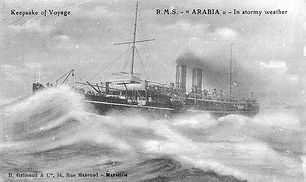
RMS Arabia was a P&O passenger liner torpedoed on 6 November 1916 by the German submarine UB-43. It also had the first children's playroom when launched.
She was built 1898 at Caird & Co in Greenock to carry 480 passengers and served mostly on the Australian trade. There are very few records of the vessel, but a sister ship, (the Egypt) is described as length 500ft x beam 54.4ft, two funnels, single screw, speed 16 knots.
It was on a homeward bound journey from Fremantle and was destined for England when it was sunk without warning by a German U-boat 300 miles off the coast of Malta towards the Greek peninsula Cape Matapan. Eleven of the crew were killed in the sinking. 187 Australians were on board the Arabia, and the sinking helped surge volunteer enlistment in the Australian armed forces. Survivors were rescued by four armed trawlers and Ellerman Lines "City of Marseilles".
https://military-history.fandom.com/wiki/RMS_Arabia
Click on the links below to read telegram from United States of America to Foreign Office, Berlin and reply from Berlin in regard to the sinking of the Arabia.
https://history.state.gov/historicaldocuments/frus1916Supp/d412
https://history.state.gov/historicaldocuments/frus1916Supp/d421

Whilst in England, Henry met Margaret who had joined the RAF with her sister, Gertrude. They worked at Cranwell Camp in England making weapons of war. Henry and Margaret wed in 1918 in England and in July 1919 sailed to Australia on board "Bahia Castillo". (See below for the saga of "The Bahia Castillo Affair")
Gertrude followed, departing London on 6 December 1923 on board "Demosthenes", arriving in Brisbane on 29 January 1924 and in 1926 married Henry's brother, Roy Otto.

Roy, Gertrude, Margaret & Henry

The Bahia Castillo Affair
The saga begins in Plymouth, England, in July 1919 and ends in Sydney in October 1919. The discontent onboard culminated in a Royal Commission held in Melbourne in October 1919. Henry Paul Otto and his English wife, Margaret, were among the passengers on board. It would be no surprise if Henry decided never to set foot on another ship again, having been on the "Arabia" when it was torpedoed on his way to England in 1916.
(Rest on the images below for description)

(Photo NAA Series A 1952)

Australian War Memorial HO1972

Australian War Memorial HO1971
(Photo NAA Series A 1952)
Click on above image and then navigation arrows to view all images

Bahia Castillo docked at a wharf
The Bahia Castillo was built for the German Hamburg South American Line in 1913. It had been laid up during the war, then surrendered to the British in 1919. Its configuration for 2000 passengers was upgraded to a 'family ship' carrying on this voyage 586 Munition Workers, 342 wives and children and 21 Army medical personnel.

This Passenger List indicates Brisbane as the Port of Arrival, however, the Bahia Castillo finished its journey in Sydney and it is believed Brisbane passengers then travelled by train to their final destination.
An article appeared in The Fremantle Herald on Friday, 26 September 1919, page 1 titled "The Frightfulness of Militarism - The Bahia Castillo Outrage". (The full article can be read by clicking on the link.) Some of the comments are:
"Constant breakdowns, drunkenness of Officers and Crew, putrid food, rank meat, putty like bread, stinking vegetables, and a gang of hooligan Stewards. All of these things help towards the unspeakable discomfort of the passengers on the Bahia Castillo."
"The passengers were returning munition makers a fine sturdy body of men and gentle womenly women with bright children, some weak with want of food."
In Durban, the Captain demanded an armed guard which lead to the further comment in the article:
"Then came the (Brookara) with her cargo of questionable things in uniform and 70 uniformed degenerates were obtained."
There are more than thirty newspaper articles about the voyage and the Royal Commission - a few of the headlines are:
"Neglect of Child Alleged" - The Herald, 24 Nov 1919
"A Wild Howling Mob" - The Age 25 Nov 1919
"Purple Pudding" - Argus 25 Nov 1919
"Nothing to Complain Of Inquiry Witnesses Say" - Herald 19 Nov 1919
"Evidence By Doctors - A Particularly Healthy Ship" - Argus 19 Nov 1919
"Nurses Give Evidence - Children Well Cared For" - Argus 20 Nov 1919
The outcome of the Royal Commission was that the majority of the complaints were disproved. (The full text can be read by clicking on the link.) Among the documents located in an NAA Records Search, there is a Telegram from District Naval Officer, Fremantle dated 24 Sep 1919 which states:
"The main source of trouble was caused - in my opinion - by the selection of a Committee of four and Mr. C.W.W. Saunders as Chairman to look after the interests of passengers on the vessel leaving the United Kingdom. He (Chairman) has been the cause of trouble before on "Benalla" or "Ballarat" and caused dissension of similar nature. He is supported by four other members of whom it is believed that three are of similar mind."
What happened to the Bahia Castillo?
Ships were bought and sold and changed names, including the Bahia Castillo. According to website www.theshipslist.com in 1922 the Bahia Castillo was sold to Hugo Stinnes, Hamburg, renamed General San Martin and later General Belgrano. It was used in their South American service and in 1932 was scrapped.
There are reports of the Bahia Castillo being torpedoed and damaged off Denmark in May 1940 during WWII by HMS Narwhal. It was apparently towed into Frederikshavn and scrapped at Kiel, Germany in September 1940. This was a different ship to the one involved in the 1919 affair. This ship was originally the Gaelic Price, then Rheinfels, then sold to the Hamburg South American line and renamed Bahia Castillo.
Henry was the Otto of "Otto & Pearen", Gympie
.jpg)
The Brisbane Courier, Monday 12 January 1931, Page 6
GYMPIE. Aviation - Following the outburst of enthusiasm In glider building which is still flourishing unabated, it is learned that Mr Henry Otto, garage proprietor of Monkland Street, proposes to build a two seater aeroplane at his Service Station. Fortified by three years experience at Vickers factory in England as a fitter among aeroplanes guns and submarines, Mr Henry Otto is most optimistic regarding the project which is being financed by a well known identity of Gympie. The engine for the machine was acquired recently in Melbourne and has arrived at Gympie. The framework on which Mr Otto expects to commence work in a few days will be made of yellow wood which compared very favourably with English spruce from which good planes are being produced. All except the propeller will be constructed at the garage, and Mr Otto expects that the Job in his spare time will take four or five months. The machine will have a wing span of 28 feet and over-all length of 22 ft and a 4ft 8in cord (width of wing). Upon the completion of the plane it is proposed to take it to the Forty Mile Beach, where a trial will be made.
On 28 November 1932, a meeting was held in the Gympie Council Chambers for the purpose of forming an Aero Club at Gympie. A provisional Committee was formed with Mr H. Longland voted to the Chair. Henry Otto was one of the Committee members. It was decided to get in touch with the Show Society, requesting permission to use the showground as an aerodrome and if the Society was willing, an application was then to be made to the Commonwealth Government for a grant sufficient to convert the ground into an aerodrome for light machines.
Later, Henry left Gympie and he and his wife lived in Brisbane. He was Foreman at International Trucks Tractors & Harvesters Company in Brisbane.
James Stirling Roy (Roy) Otto
Roy was born in Brisbane on 5th October 1900. He and his brother went to school in Ravenswood and Charters Towers, Qld, where their father was working. School register shows the father as a carpenter.

Roy was mentioned in Bowen papers for sailing, town band, rugby league and delivering groceries in Bowen. A few examples follow:
27 January 1917: Bowen Band Concert, Duettes 1st Prize: J. O'Keefe and R. Otto
13 August 1918: Bowen Juniors, "Otto (among others) played the best."
6 April 1920: No 1 Dalrymple Handicap, won by Ocean Wave (Roy Otto).
9 January 1923: Port Denison Sailing Club "Ruby started off 9 mins (handicap) and did well in the hands of Roy Otto, finishing second."
Later in life it seems Roy was a keen bowler and won many championship bowls.
On 26th January 1926 Roy married Gertrude Westwood in Gympie. "Bowen Notes" in Townsville Daily Bulletin Friday 29 January 1926:
"Mr. Roy Otto, second son of Mr. and Mrs. H. Otto, of this town, was married to Miss Gertrude Westwood at Gympie during the week. The bride is a native of England, and during his residence in our midst the bridegroom has made himself very popular in yachting circles."
Gertrude departed London on 6 December 1923 on board "Demosthenes", arriving in Brisbane on 29 January 1924.

Demosthenes - front of Dinner Menu postcard

Demosthenes leaving Sydney


Gertrude


Gertrude & Roy
Roy owned a Service Station in Gympie and apparently the Service Station dog "Tim" had money for the paper tied around his neck and would go to the paper shop and return with the paper.

Ever Ready Service Station, River Road, Gympie
1934

Ever Ready Service Station, River Road, Gympie
1936

Service Station, Gympie
1937

Service Station, Cnr Monkland & Reef Sts, Gympie
1947 flood

Service Station, Cnr Monkland & Reef Sts, Gympie
1947

Roy Otto with dog, Tim
Lillian Otto
Lillian was born on 22 February 1903, in Ravenswood, Queensland. She died on 22 May 1978 (aged 75 yrs) and is buried in the Gympie Cemetery.
She married Roy Holyoke Cordell on 22 August 1928. Roy was born on 9 March 1896 and died on 13 July 1988 (aged 92 yrs). He is buried with Lillian in Gympie Cemetery.
Roy Cordell enlisted in the Australian Imperial Force on 24 May 1917 at the age of 21 years. He embarked Sydney 14 June 1917 on board HMAT "Hororata" and disembarked Liverpool 25 August 1917. During the journey he was hospitalised on board ship with Influenza. He was also admitted to Parkhouse Hospital, England on 6 September 1917 with Mumps and on 2 May 1918 admitted to Sutton Veny Hospital, England, with Measles.
He returned to Australia aboard "Raranga" departing England on 8 September 1919 and arriving in Australia on 29 October 1919, due to old injury to left ankle.
His occupation on enlistment was "Farmer" but on discharge it was "Butcher". It appears he cut his left thumb whilst on board "Raranga" which became septic and upon arrival in Australia spent some time at the 6th AGH (Australian General Hospital), Kangaroo Point. He was discharged from the AIF on 12 January 1920, unfit for General Service.

Cordell, RH
The Queenslander Pictorial Sept 1917
Electoral Roll records show that Roy worked as a butcher in a few locations in Queensland, namely Wondai, Amamoor and Gympie until settling in Imbil in about 1954 where he operated the butcher shop in Yabba Road until about 1980.
